You passed the evaluation. Congrats. Now comes the part everyone actually cares about: getting paid.
The good news? Alpha Futures runs one of the more straightforward systems in the futures prop world. Their own COO, Benjamin Chaffee, sums it up bluntly on the help center: follow the rules, and you will be paid out. No hidden denials. No mystery clauses. You hit the criteria, you click the button, the money moves.
But “straightforward” doesn’t mean “no details to learn.” There are minimums, maximums, winning-day requirements, a consistency rule that applies to one plan, and a tiered profit split that scales over time. Miss one of these, and your payout request sits there blinking at you on the dashboard.
This is the full breakdown of Alpha futures payout policy as of May 2026, pulled directly from the help center, the FAQ, and the policy pages for each account type. Premium, Advanced, Zero, payment methods, the MLL trap, Alpha Prime, fees, timing, all of it.
The core rules that apply to every funded account
Before splitting into plans, there are four rules every trader lives by. These don’t change whether you have a zero account or a 150k Advanced.
1. Four payouts per month, max: You can pay yourself up to four times in a calendar month. That’s the ceiling.
2. Five winning days between cashouts: Every request requires five winning trading days of $200 profit or more since your last withdrawal. The days don’t have to be consecutive. You just need five in the bank before requesting again. Have a stretch of small wins under $200? Those don’t count toward the five. Painful but fair.
3. 50% of profit each cycle: You can withdraw 50% of the profit sitting in your account each time, capped by your plan’s limit. The rest of the balance stays on the account, acting as your buffer against drawdown and feeding future cashouts. So when you withdraw 50, the other half keeps working for you.
4. 90% profit split: Every withdrawal request gets paid at 90%. Request $5,000, receive $4,500. The remaining 10% is the firm’s cut. That tiered profit progression on the old Standard plan? Retired. The flat 90% now applies across Premium, Advanced, and Zero.
All payments are processed in 48 business hours or less. Saturdays and Sundays don’t count toward that window, so a Friday-evening request technically starts processing Monday morning. Plan accordingly if you’re chasing cash flow timing.
Now the part that splits per account type.
The breakdown of the Alpha futures rules by plan
Alpha Futures retired the Standard plan on May 1, 2026, and replaced it with Premium. There are now three active plans: Premium, Advanced, and Zero. Each one handles caps, consistency, and minimums differently.
Premium: tiered withdrawal caps, no consistency requirement
The Premium plan rolled out as the spiritual successor to Standard, with quality-of-life upgrades borrowed from the Zero and Advanced plans.
- Minimum payout: $500
- Maximum withdrawal: scales with each payment
- Profit split: 90% on every cashout
- Consistency rule: none, but you need a positive net profit (even $1) since your last cashout
The cap scales up across the first several cycles on the account:
| Cashout # | Maximum |
|---|---|
| 1st | $3,000 |
| 2nd | $3,500 |
| 3rd | $4,000 |
| 4th | $5,000 |
| 5th and beyond | $6,000 |
The progression rewards traders using consistent activity without forcing it. There’s no consistency requirement on Premium accounts once funded, which is a meaningful shift from the old Standard policy. You just need to show the net profit between requests. Even $1 qualifies. The point is to confirm you’ve actually made money since the last cycle, not gamed the system.
Premium also offers a choice at signup: pay a $149 activation fee with lower monthly subscription pricing, or skip it and pay higher monthly fees instead. On the smallest Premium evaluation, that’s either $79/month with the 149 entry charge, or $159/month without. Same outcome, different payment shape.
Advanced: industry-leading $15,000 cap, no consistency requirement
Advanced is the plan built for users who want fewer rules and don’t mind paying more monthly to get there.
- Minimum withdrawal: $1,000
- Maximum withdrawal: $15,000 per request, per account
- Profit split: 90% from day one, flat
- Consistency requirement: none on the Advanced qualified plan
That $15,000 cap is the headline. Most prop firm competitors top out around $5,000 per request. Alpha Futures runs roughly 3x that, on every Advanced account size, every cycle. Stack a few of these, and you’ve got serious monthly cash potential.
The trade-off is the monthly cost. The Advanced 50k account evaluation runs $139/month, the 100k is $279/month, and the 150k is $419/month, plus the $149 activation fee once you pass. The flat 90% split kicks in from your first cashout. No tiered ramp, no waiting four cycles to hit full split.
No consistency requirement means you can have one outsized winning day, and it won’t lock your withdrawal button. Big news days, strong opening sessions, concentrated edges. The plan absorbs all of that without flagging anything. If your strategy produces uneven daily profits, this is the path that won’t punish you for it.
Zero: instant funding, size-capped cashouts, 40% consistency rule
The zero account is the budget entry point. No evaluation activation fee. Pass in a single day if you have the edge. Funded the moment you sign up and hit the criteria.
- Minimum withdrawal: $200
- Maximum on 25k zero account: $1,000 each cycle
- Maximum on 50k size: $1,500 each cycle
- Maximum on 100k size: $2,500 each cycle
- Profit split: 90% from the start
- Consistency rule: 40% on the zero-qualified plan
The 25k zero account is the cheapest funded path Alpha Futures offers at $79/month, the 50k Zero runs $119/month, and the larger size is $239/month. There’s no $149 activation fee on Zero. It’s just the monthly subscription until you stop trading the plan.
The size-capped maximums reflect the lower-risk structure of the zero plan. You’re getting instant funded access without the evaluation gauntlet, so the firm caps your maximum withdrawal each time to manage exposure on their side. Fair trade.
And then there’s the 40% rule.
How does the 40% consistency rule actually work on zero qualified accounts?
The rule here says no single trading day’s profit can equal or exceed 40% of your total net profit since your last cashout. If it does, the button on your dashboard goes dark until your largest day’s share drops below 40% through continued trading.
The math, straight from the help center calculator:
Biggest day ÷ Total net profit since last request = Consistency %
If your biggest day’s profit is $1,400 and your total net profit since the last cycle is $3,000, you’re at 46.6%. Locked. Keep trading, add a few hundred more in profit across other days, and the percentage drops. Hit $3,600 total with the same $1,400 biggest day, and you’re at 38.9%. Cleared.
A few things worth knowing about how Alpha Futures handles this:
- The rule resets after every cashout. Your “since last request” counter starts fresh once you receive the funds. So requesting more often actually helps you manage the math more tightly, since you’re working with smaller denominators.
- Premium and Advanced qualified accounts have no equivalent rule at all.
- Alpha Futures provides a live calculator at consistencycalculator.alpha-futures.com so you can check where you stand before clicking the button.
- During the evaluation phase (Premium and Advanced), a 50% consistency requirement applies to pass. Zero evaluations have no such rule at all, which is part of why the plan can pass in a single trading day.
If you’re a trader whose edge produces one or two big days a month and a lot of small ones, the zero plan’s 40% rule will frustrate you. Advanced is the safer fit for that profile.
Beyond the rules: MLL, payments, and Alpha Prime
How do payments interact with your maximum loss limit?
This is the rule that catches more traders than any other policy-related issue at Alpha Futures. Read this section twice.
When you pull profit, the balance drops by the full requested amount. Your loss limit, the floor your account balance can’t touch, does not drop with it. So if you grow your 50k account from $50,000 to $55,000, your floor might still sit around $49,200 (depending on whether the trailing drawdown has locked in place). If you request all $5,000 in profit:
- You receive $4,500 (90% of the request)
- Your account balance returns to $50,000
- Your floor is still $49,200, sitting just $800 below your balance
You’ve now got almost no buffer left. One bad session and the account breaches.
The fix is to leave room above the floor when requesting. Don’t take everything. The 50% each time rule actually helps with this, since you can’t drain the full balance in one shot. But users still get aggressive with multiple consecutive cashouts and breach themselves out.
Worth noting that Alpha Futures does not slide the loss floor to zero or reset it after a cashout. Some competitors punish small withdrawals by sliding it to your starting balance the first time you pull money. Alpha doesn’t. If your floor was $49,200 before, it stays $49,200 after. That’s a trader-friendly piece of the policy you should take advantage of by pulling profit in measured chunks rather than dumping everything at once.
Payment methods and how long they actually take
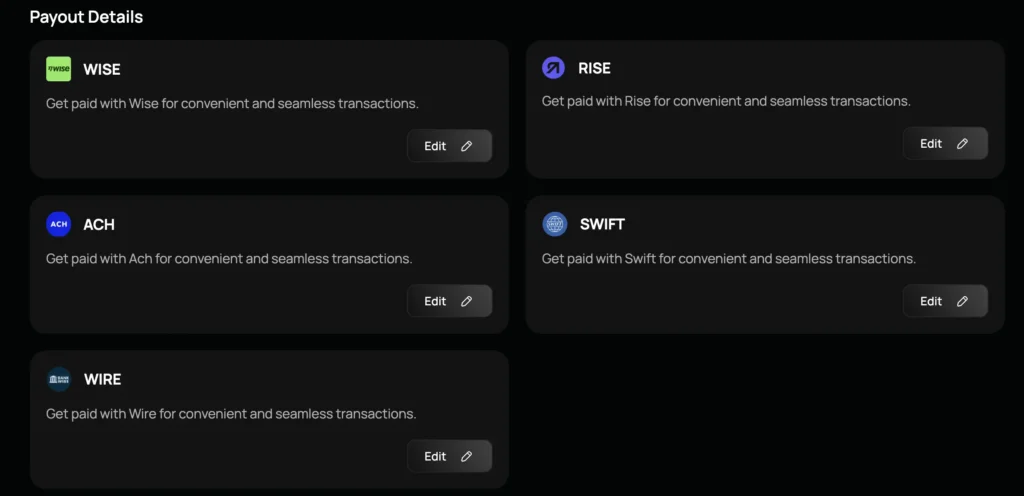
Alpha Futures supports five payment methods, all paid in USD regardless of which one you choose:
- ACH: US-based users only. Free, predictable, and settles in 1-2 business days after Alpha approves the request.
- Wire Transfer: US and international. Faster than ACH for some banks, but typically charges $10-$25 in fees.
- SWIFT: International bank transfers. Reliable, but bank fees of $25-$80 are common.
- Wise: International, 50+ currencies supported. Strong settlement speed and lower fees compared to SWIFT.
- Rise: Alternative rail, also supports crypto cashout for international users. Requires a one-time signed agreement before your first payout, so handle that paperwork in advance to avoid delay.
For the first payout specifically, expect a small extra delay regardless of method while KYC and your trader agreement are finalized. After that, the 48-hour window is what most users report seeing consistently.
The takeaway: pick the method that fits your geography. ACH for US, Wise or Rise for international, SWIFT or wire if your bank handles those better than the alternatives.
Daily payouts, daily loss, and a few things Alpha Futures offers that competitors don’t
A few notes that don’t fit neatly anywhere else.
Are there daily payouts on Alpha Futures? No. The five winning days requirement effectively makes the fastest possible payout cycle a weekly one on Advanced and Zero, and a 14-day rhythm was the old Standard cadence. There’s no daily payout structure here.
Daily loss limits? Premium, Advanced, and Zero funded accounts have no Daily Loss Guard during evaluation or funded phases. The MLL is the only loss-side rule that closes simulated accounts on these plans. (Alpha Prime live accounts have a 30% daily loss soft pause, but that’s a different product.)
News trading rule? Premium and Advanced have specific news trading windows defined in the firm’s news trading policy. Advanced qualified is the most relaxed; Zero and Premium have buffer requirements around scheduled high-impact news. Check the help center for the current list of restricted events.
Multi-account limits: You can hold up to five accounts on the zero-qualified plan and up to three Premium or Advanced funded accounts simultaneously. Each one has its own cycle, so if you’re running multiple, you can stack payments across them.
Platforms supported: Alpha Futures runs on Tradovate, NinjaTrader, Quantower, TradingView via Tradovate, and a couple of more boutique options like Deepchart. Your platform choice doesn’t affect the rules.
Alpha Prime: Path from Simulated to Live Capital
Worth mentioning because it changes the cash-out structure entirely once you get there.
When your simulated funded account hits a +$40,000 payable balance or completes five cashouts, Alpha Futures reviews your trading history for the opportunity to move to live funds through Alpha Prime. They can also initiate this review earlier at their discretion.
When you move to Alpha Prime:
- All your simulated accounts get closed
- Alpha processes 50% of the account’s profit as a final cashout (capped at the plan’s normal maximum withdrawal, so $1,500 to $15,000 depending on size)
- $5,000 of the remaining balance funds your live account
- Alpha matches that with another $5,000 from the firm
- You start with a $10,000 static drawdown live account and a choice: 60% split with the full Alpha Prime development program (weekly strategy calls, quant support, monthly salary), or 80% split without it
The Alpha Prime side runs differently from the funded sim. You’re trading real firm capital at that point, not paper money, so the rules tighten in some places and loosen in others. Most users won’t get there in their first few months, but it’s the carrot at the end of the evaluation-to-live pipeline.
Common Queries Related to Alpha Futures Payout Policy
How often can I request a payout on Alpha Futures?
What is the profit split on Alpha Futures qualified accounts?
Does the consistency rule apply to all Alpha Futures plans?
What is the maximum withdrawal on an Advanced qualified account?
Does withdrawing profit reset my Maximum Loss Limit on Alpha Futures?
What payment methods does Alpha Futures support for processing trader withdrawals?
What do you actually need to remember?
If you take nothing else away from this:
- Five winning trading days of $200+ before you request a withdrawal. Always.
- Four payouts per month, max, across any single account.
- 50% of profit per cycle, up to your plan’s cap.
- 90% profit split on every cashout across Premium, Advanced, and Zero.
- 48 business hours processing, weekends don’t count.
- 40% consistency rule only on the zero-qualified plan. Premium and Advanced have none once funded.
- Your MLL does not move when you withdraw. Leave a buffer or breach yourself out.
- $149 activation fee on Premium and Advanced after passing the evaluation. Zero has none. The fee is a one-time charge per funded account, not recurring.
The alpha futures payout system rewards traders who treat their initial investment in the evaluation seriously, manage drawdown like adults, and don’t try to game the 40% rule on the zero plan. Plan your cashouts around your loss-limit buffer, request often enough to keep the consistency math working in your favor, and pick the plan that matches your edge. Advanced if your profits are concentrated, Premium if you want tiered scaling without consistency drama, Zero if you want the cheapest funded path and can keep your days balanced.
Then click the button. The money moves.
For the absolute latest on alpha futures payout rules, the activation fee structure, monthly fees, premium account sizes, or the parameters on any specific plan, always check the Alpha Futures help center directly. Policies update, and a quick visit before your first cashout beats finding out about a change the hard way.