Look, if you’ve been trading futures for any amount of time, you know that seeing green on your account is one thing—actually getting paid is another story entirely. I’ve seen too many traders hit their profit targets, get excited about requesting a payout, only to have their request denied.
Why? Payout buffers (Apex Trader Funding Payout Buffer in our scene)
At Apex Trader Funding, like most prop trading firms, there’s this extra layer between your profits and your bank account called a payout buffer. And honestly, understanding how payouts work at Apex before you start trading can save you a ton of frustration down the road.
What’s a Payout Buffer Anyway?
Here’s the deal: a payout buffer is basically the minimum account balance you need to keep in your funded account after you request a payout. It’s not just some arbitrary number Apex came up with to make your life difficult—though I know it can feel that way when you’re sitting on profits you can’t touch.
Think of it this way: the buffer is the cushion that has to stay in your performance accounts no matter what. You can’t withdraw it. Period. This applies whether you’re trading a 50k account or running multiple funded accounts—each one has its own buffer requirement.
Why Do Prop Trading Firms Even Use These Things?
I get it—you’re profitable, you want your money. But here’s why apex payout rules include these buffers: they’re protecting both themselves and you from account blowups after withdrawals.
Without a buffer, you could theoretically pull out so much that one bad trading day would violate your drawdown limit and boom—account closure. Apex trader funding payout rules are designed to keep your funded account at a registered broker stable enough to weather normal market swings.
It’s about risk management, plain and simple. These funding programs want you to succeed long-term, not just grab a quick payout and blow the account. They’re looking for consistency over time, not windfall trading.
How do Apex Payout Rules Actually Work in Practice?
Alright, let’s get into the specifics of how Apex enforces these rules, because this is where a lot of traders get tripped up.
Your Account Balance Matters More Than You Think
Here’s something that catches people off guard: at Apex Trader Funding, payout eligibility isn’t just about being profitable. Your current account balance has to be above a specific minimum level that includes the buffer. If your balance drops below that threshold—even if you’re technically up overall—your request a payout button might as well not exist.
This means you need to plan your trading strategies around maintaining that balance, not just chasing profits. I’ve seen traders make good money only to realize they can’t access it because they took a few losing trades that brought their balance too close to the minimum.
The Brutal Truth: Profits ≠ Payouts
This is probably the biggest misconception I see, especially from traders new to funded trading. You can be profitable and still be completely ineligible to request payouts. How? Because withdrawing funds would leave the account balance below the required buffer.
Apex isn’t just looking at whether you made money—they’re evaluating your capital preservation and whether you’re following responsible trading strategy principles. The buffer ensures you’re not just a profitable trader but a disciplined one who manages risk properly.
The Numbers: Minimum Balance Requirements by Account Size
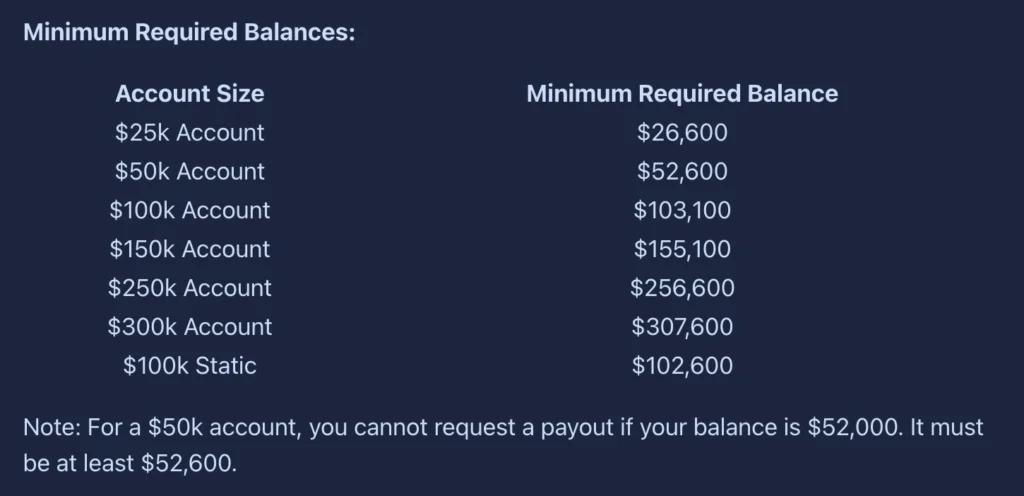
Let me break down the actual minimum required balance for different account sizes at Apex. These numbers already factor in the drawdown based on the account size plus a safety margin:
Apex Trader Funding Payout Buffer Requirements:
- $25,000 account: Must maintain $26,600
- $50,000 account: Must maintain $52,600
- $100,000 account: Must maintain $103,100
- $150,000 account: Must maintain $155,100
- $250,000 account: Must maintain $256,600
- $300,000 account: Must maintain $307,600
- $100,000 Static account: Must maintain $102,600
Notice how these are all higher than the starting balance? That’s the buffer in action.
Real Example: When Being Profitable Isn’t Enough?
Let me give you a scenario I see all the time. Say you’re trading a 50k account:
- Your current balance: $52,000
- Minimum required balance: $52,600
You’re up from your starting balance of $50,000. You made $2,000. Great trading day, right? But you still can’t request the minimum payout of $500 because meaning the account balance must stay at or above $52,600 after the withdrawal.
This frustrates the hell out of new traders, but once you understand the funding payout rules, it makes sense. You need to get your balance to at least $53,100 ($52,600 buffer + $500 minimum payout) before you can actually take anything out.
How Payout Buffers and Trailing Drawdown Work Together?
Here’s where things get a bit more nuanced. A lot of traders confuse payout buffers with trailing drawdown, but they’re completely different risk management techniques.
Trailing drawdown controls how much you can lose while actively trading. Once your account reaches a balance above a certain trailing threshold, that drawdown stops moving up with your profits—it locks in.
Payout buffers, on the other hand, control how much equity you can actually withdraw from your performance accounts.
Here’s the key thing: even when your trailing drawdown stops moving, and you’re protected from drawdown-based account liquidation, apex payout rules still apply. You might be safely above your drawdown limit but still unable to request payouts if the buffer requirement isn’t met.
Quick Comparison
- Trailing Drawdown: Maximum allowable loss before account closure
- Payout Buffer: Minimum balance that must remain after withdrawal
Understanding both is crucial for becoming a funded trader who actually gets paid consistently.
Timing Rules You Need to Know
Beyond just having the right balance, Apex requires you to follow specific timing rules for payouts work properly:
Core Apex Payout Rules:
- Minimum payout amount: $500
- Must wait at least 8 trading days between payout requests
- Account balance must stay above the required buffer after the payout is approved
- Only the authorized user is trading or accessing the account (no account sharing)
These apply across all account sizes and all multiple accounts you might be trading.
Maximum Payout Limits (This Applies to First Three Payouts)
For your first few payouts, Apex Trader funding strictly prohibits taking massive withdrawals. Here are the caps:
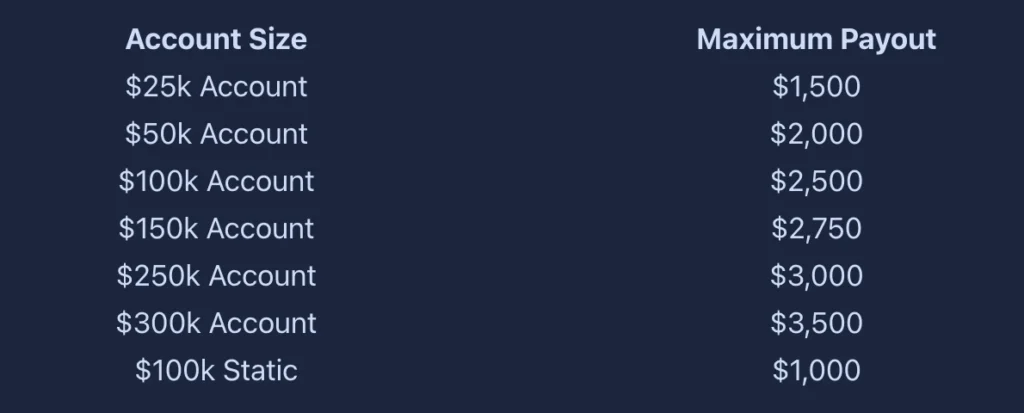
After your first three approved payouts, these caps eventually get removed. But you still need to maintain the required buffer—that never goes away.
Why Payout Buffers Actually Matter for Your Trading Career?
I know these rules can seem restrictive, but here’s the reality: payout buffers aren’t designed to screw you over. They’re there to keep your funded account viable over time.
I’ve watched traders pull aggressive payouts and then find themselves:
- Trading way too close to their drawdown limits
- Losing all flexibility during normal market volatility
- Getting their accounts terminated shortly after a recent payout
- Unable to implement proper trading strategies because they have no cushion
By enforcing these funding payout rules, Apex seeks to fund traders who think long-term, not those stockpiling evaluation accounts to cycle through in pursuit of windfall profits.
Common Mistakes Traders Make With Payout Buffers
Let me save you some headaches by pointing out the most common screwups I see:
Assuming Profits = Automatic Payouts
This is the big one. Being profitable doesn’t automatically make you eligible to request a payout. You need to maintain the buffer. I see traders hit their profit target during the evaluation phase, then carry that same mindset into their live prop trading account and get confused when the rules are different.
Confusing Profit Targets With Payout Buffers
Profit targets apply during your evaluation accounts. Payout buffers apply after you’re funded. These are completely separate things, and mixing them up leads to wrong expectations about when you can actually withdraw.
Not Accounting for How Withdrawals Affect Future Risk
Here’s something most traders don’t think about: if you request the minimum payout and it leaves your account balance just $100 above the required buffer, you’ve basically put yourself in a dangerous position. One bad trading day and you could be facing account closure, even if you’re still technically profitable overall.
Ignoring the 8 Trading Day Rule
You can have all the money in the world in your account, but if it hasn’t been 8 trading days since your last payout, you’re not getting another one. Period. This trips up traders who think they can just take small, frequent withdrawals. The consistency rule is there for a reason.
Who Really Needs to Pay Attention to These Rules?
Look, all traders need to understand payout buffers, but some need to be extra careful:
- Traders who use tight risk management and operate close to their limits
- Anyone trading multiple funded accounts simultaneously
- Scalpers and high-frequency trading practitioners who take lots of positions
- Traders planning early or frequent withdrawals
- Anyone trading volatile instruments where the account balance can swing quickly
If that’s you, understanding how these buffers interact with your daily performance is critical. You can’t afford to be caught off guard.
Before You Hit That Payout Request Button
Here’s my pre-flight checklist before submitting any payout request:
- Check your balance: Is it above the minimum required buffer for your account size?
- Do the math: Will your balance stay above the buffer after the payout?
- Count the days: Has it been at least 8 trading days since your last withdrawal?
- Know the cap: If this is one of your first three payouts, are you within the maximum limit?
- Review your trading: Has there been any unusual activity that might trigger a review?
Remember, these are clear rules that Apex enforces automatically. If your request doesn’t meet the requirements, it gets declined—doesn’t matter how good your trading account looks otherwise.
What Happens If You Violate the Rules?
Apex reserves the right to request additional verification or even close accounts that violate their trader agreement. This includes:
- Manipulation of trading during probation periods
- Erratic trading styles designed to game the system
- Operating new and existing accounts with the same risky approach
- Trying to restore your account to good standing through prohibited methods
They’re particularly strict about traders using discounted evaluation accounts to cycle through multiple account attempts, essentially gambling rather than trading. That stuff will result in account closure across all your accounts over time.
The Reality of Trading in This Environment
Here’s my honest take after trading with various prop firms: the simulated trading environment at Apex, like other trader funding programs, is designed to identify traders who can manage risk consistently. The payout buffer is part of that test.
If you approach this like a personally funded account where you can do whatever you want, you’re going to struggle. But if you adapt your trading strategies to work within these funding payout rules, you can build a sustainable income from trading futures.
The traders who succeed long-term at Apex aren’t necessarily the most profitable—they’re the ones who understand that maintaining their funded account at a registered broker requires discipline around both risk management techniques and withdrawal timing.
Set Realistic Expectations
The biggest favor you can do for yourself is understanding these apex payout rules before you start trading, not after your first payout request gets denied. I’ve seen too many talented traders get frustrated and quit because they didn’t grasp how the payout structure works.
These buffers exist to protect the trading environment and ensure that only serious traders with sustainable approaches get funded. Yeah, it means your money isn’t always available the second you want it. But it also means your account is more likely to survive long enough to actually build a track record.
If you’re coming from trading your own capital, the adjustment takes time. But once you understand how apex trader funding payout buffers work, you can plan your trading and your withdrawals accordingly. And honestly? That’s when you stop fighting the system and start making it work for you.
Trade smart, manage your risk, respect the buffer, and the payouts will come. Just maybe not as fast as you’d like—but that’s prop trading for you.
Common Queries Relevant to Apex Trader Funding Payout
What is a Payout Buffer at Apex Trader Funding?
A payout buffer is the minimum account balance required to remain after requesting a withdrawal from your funded account.
Can I withdraw profits if my Apex account is profitable?
No. Profitability alone doesn’t guarantee payout eligibility; your balance must meet the specific buffer requirement for withdrawals.
What is the minimum payout amount at Apex Trader Funding?
The minimum payout amount is $500, and you must wait 8 trading days between consecutive payout requests.
What happens if my balance falls below the payout buffer?
Payout requests are automatically denied until your account balance is restored above the required minimum buffer threshold.
What is the payout buffer for a $50,000 Apex account?
A $50,000 account requires maintaining a minimum balance of $52,600 to remain eligible for payout requests.
Are there maximum payout limits at Apex Trader Funding?
Yes. Maximum payout caps apply to your first three approved payouts, ranging from $1,000 to $3,500 depending on account size.