
If you’re considering trading with Apex Trader Funding, understanding how Apex Trader Funding’s trailing drawdown works should come before looking at profit targets or payouts. Trailing drawdown is the primary risk rule that determines how much room a trader has to operate, and it behaves very differently from a fixed loss limit.
At Apex, the drawdown adjusts based on the highest account equity reached during trading, including unrealized gains, which can surprise traders who are unfamiliar with this structure.
This guide explains how Apex Trader Funding trailing drawdown works in real trading conditions, why it exists, and what futures traders should be aware of before starting an evaluation or performance account.
What Is Trailing Drawdown in Futures Prop Trading?
Trailing drawdown is a risk control used by futures prop trading firms to limit losses while an account is growing. Instead of staying fixed at one level, the drawdown moves upward as the account reaches new equity highs, tightening the allowable loss threshold over time.
This is very different from a static (fixed) loss limit, where the maximum loss is set once and never changes. With a static drawdown, traders always know the exact level that cannot be breached. With a trailing drawdown, that level changes dynamically as performance improves.
Prop trading firms use trailing drawdown models because they reward consistency and capital protection rather than short-term gains. The goal is not just to see if a trader can make money, but whether they can protect profits and manage risk as the account grows. Traders who rely on large drawdowns or allow profits to retrace often struggle under this model fully.
In simple terms, trailing drawdown tests how well a trader controls downside after showing upside.
Trailing Drawdown vs Static Drawdown at Apex Trader Funding
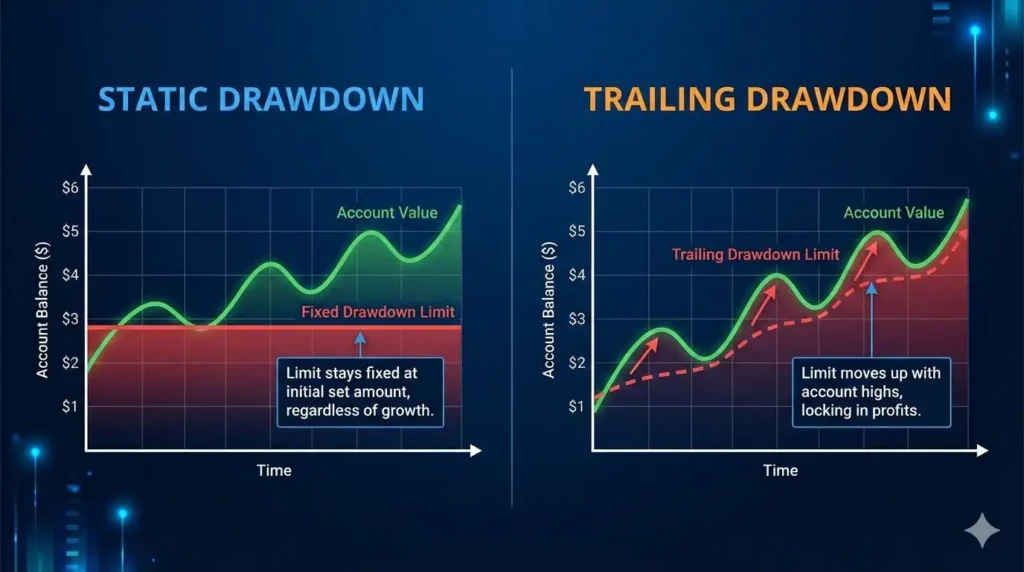
At Apex Trader Funding, traders can encounter two different risk models: trailing drawdown and static drawdown. While both exist to limit losses, they behave very differently and suit different trading styles.
With trailing drawdown, the loss limit moves upward as the account reaches new equity highs. It reacts to both realized and unrealized profits and tightens risk as performance improves. This model rewards traders who can protect gains and manage open risk carefully, but it also requires active monitoring during the trading day.
In contrast, static drawdown uses a fixed loss limit that does not move once the account is created. The maximum loss is known in advance and remains unchanged regardless of how high the account balance goes. This provides clarity and predictability, but it typically comes with stricter profit targets or tighter overall limits.
From a practical standpoint:
- Trailing drawdown favors disciplined traders who scale slowly and lock in profits.
- Static drawdown tends to suit traders who prefer clearly defined risk boundaries and less intraday complexity.
The key difference is adaptability versus certainty. Trailing drawdown adjusts dynamically with performance, while static drawdown remains constant. Understanding which model aligns better with your trading behavior is essential before choosing an Apex account, as neither approach is inherently easier—just different in how risk is enforced.
How Trailing Drawdown Works at Apex Trader Funding?
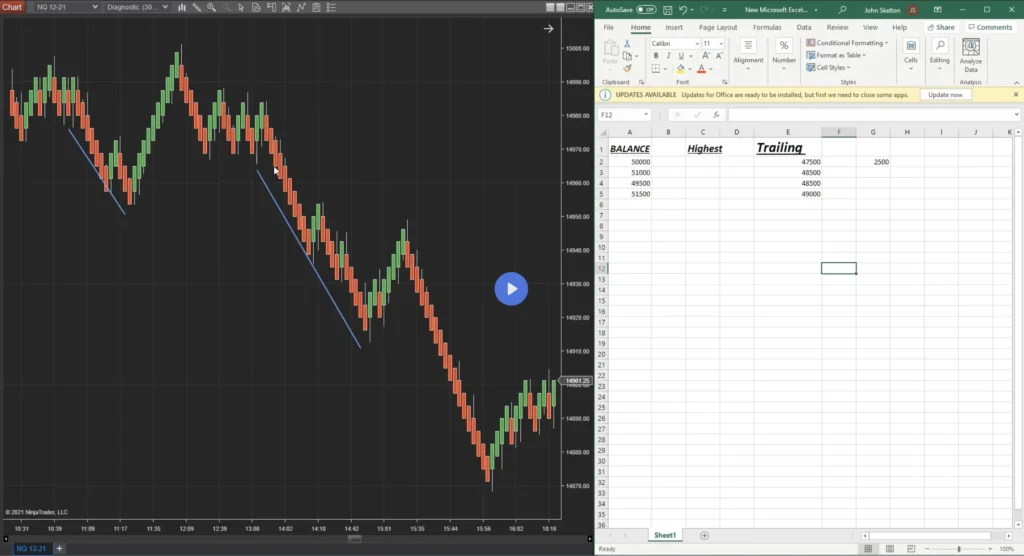
At Apex Trader Funding, trailing drawdown is calculated based on the highest account equity reached, not just the account balance at the close of a trade. This distinction is critical and often misunderstood.
When an Apex account starts, the trailing drawdown is set at a fixed distance below the starting balance, based on the plan’s maximum drawdown. As the account gains value, the drawdown threshold moves up in lockstep with the highest equity peak, including unrealized profits during open trades.
For example, if an account reaches a new equity high while a position is still open, the trailing drawdown immediately adjusts upward—even if the trade later closes with less profit. The drawdown does not move back down when losses occur. Once it rises, it stays there.
Apex also uses a defined safety net. When the account equity reaches a specific level (initial balance plus the maximum drawdown amount plus a small buffer), the trailing drawdown stops moving upward and becomes fixed. Until that point, however, the drawdown continues to trail the highest equity achieved.
This is why unrealized profits matter so much at Apex. A trade that briefly shows a large open gain can tighten the drawdown window significantly, leaving less room for error afterward. Traders who do not actively manage open risk often find themselves stopped out or failing the account despite being profitable overall.
Initial Drawdown Threshold Explained
When an Apex account is first created, the trailing drawdown starts at a clearly defined initial drawdown threshold. This threshold is calculated by subtracting the maximum allowed drawdown from the account’s starting balance.
For example, on a $50,000 account with a $2,500 trailing drawdown, the initial liquidation threshold begins at $47,500. This level represents the maximum loss allowed at the very start of the evaluation or performance account. If the account equity touches or falls below this level at any point, the account fails.
What’s important to understand is that this initial threshold is not permanent. It exists only until the account begins to grow. As soon as the trader generates profits and reaches new equity highs, the trailing drawdown begins to move upward.
This starting threshold is designed to give traders some breathing room early on, but it quickly becomes less relevant as performance improves. Many traders mistakenly focus only on the starting drawdown number and fail to account for how quickly it changes once the account starts gaining equity.
How the Trailing Drawdown Moves During Trading?
At Apex Trader Funding, the trailing drawdown moves based on the highest equity peak achieved, not the closing balance of trades. This includes unrealized profits from open positions.
Here’s how it works in practice:
- When the account reaches a new equity high, the trailing drawdown immediately adjusts upward.
- The adjustment is calculated as:
Highest equity achieved − maximum drawdown - Once the drawdown moves up, it never moves back down, even if the account later loses money.
For example, if a $50,000 account with a $2,500 drawdown reaches $50,500 during an open trade, the trailing threshold moves up to $48,000. If the account later peaks at $52,000, the threshold tightens further to $49,500. Even if the trade closes with less profit, the drawdown stays locked at the higher level.
This behavior is what catches many traders off guard. A brief spike in unrealized profit can significantly tighten the allowable loss window, leaving very little margin for subsequent trades. Because the trailing drawdown reacts to equity highs, not realized gains, traders must manage open positions carefully rather than assuming unrealized profits are “safe.”
Understanding this movement is critical. The trailing drawdown is not just a background rule—it actively reshapes risk throughout the trading session.
Practical Examples Using Real Account Sizes
To understand how trailing drawdown behaves at Apex Trader Funding, it helps to walk through realistic account scenarios. These examples use the same mechanics described in Apex’s official rules and reflect how traders experience drawdown changes during live trading.
Example 1: $50K Account With Trailing Drawdown
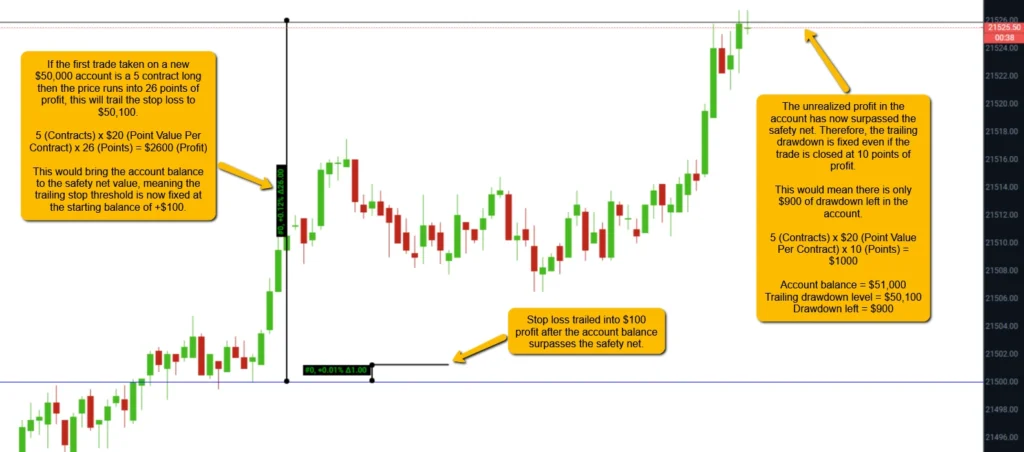
A $50,000 account typically starts with a $2,500 trailing drawdown.
- Starting balance: $50,000
- Initial drawdown threshold: $47,500
If a trader’s open position pushes account equity to $50,800, the trailing drawdown immediately moves up to $48,300 ($50,800 − $2,500). Even if the trade later closes at $50,300, the drawdown stays fixed at $48,300. The trader now has less room for error than at the start.
If equity later reaches $52,000, the drawdown tightens again to $49,500. At this point, a relatively small losing trade can cause an account failure, even though the trader is still well above the original balance.
Example 2: Why Unrealized Profits Matter?
Consider a trader who allows open profits to fluctuate without managing exits. A trade briefly spikes to a new equity high, tightening the drawdown, but then retraces significantly before closing. The trailing drawdown adjusts upward at the peak and does not relax when profits are given back.
This is why many traders feel caught off guard: the account can fail after a profitable day simply because earlier unrealized gains tightened the drawdown window.
Example 3: Slower Growth, More Flexibility
A trader who builds the account gradually—locking in smaller gains and avoiding large equity spikes—often maintains more flexibility. By controlling how quickly equity highs are set, the trailing drawdown rises more slowly, giving the trader additional breathing room over time.
Common Trailing Drawdown Mistakes Traders Make
Many traders who fail an Apex account are not unprofitable—they simply misunderstand how trailing drawdown behaves in real time. One of the most common mistakes is allowing open profits to fully retrace. Because the drawdown adjusts to the highest equity reached, giving back unrealized gains can quickly place the account near its liquidation threshold.
Another frequent issue is scaling position size too aggressively after early wins. A single strong trade can tighten the trailing drawdown significantly, leaving little margin for normal market fluctuations on subsequent trades. Traders often underestimate how quickly the allowable loss window can shrink.
Some traders also make the mistake of monitoring closed P&L instead of account equity. At Apex Trader Funding, trailing drawdown reacts to equity highs, not just settled profits, so focusing only on closed trades can give a false sense of safety.
Finally, treating trailing drawdown as if it were a static loss limit leads to poor risk decisions. Static drawdown allows for recovery after losses; trailing drawdown does not. Once the threshold moves up, it becomes the new permanent floor.
How Trailing Drawdown Affects the Evaluation Phase?
During the evaluation phase, trailing drawdown has a direct impact on whether traders can realistically reach the profit target. Because the drawdown tightens as equity increases, traders are often forced to slow down their approach rather than push for quick gains.
This is why many evaluations fail despite showing positive performance. A trader may technically be profitable, but a brief equity spike early in the evaluation can severely limit flexibility for the rest of the process. Combined with the requirement to trade over multiple days, this forces consistency rather than short-term performance.
Trailing drawdown also influences how traders pace their trading days. Instead of aiming to hit the profit target in one or two sessions, successful traders tend to spread gains across several days, keeping equity growth controlled and drawdown movement gradual.
How Trailing Drawdown Affects Funded (Performance) Accounts?
Once a trader moves from evaluation into a funded (performance) account, trailing drawdown does not disappear—it continues to shape how the account must be managed. At Apex Trader Funding, the same core mechanics apply: the drawdown is tied to the highest equity reached and does not loosen after losses.
The key difference in a performance account is what’s at stake. Funded traders are now eligible for payouts, but trailing drawdown directly affects payout eligibility and account longevity. A sudden equity spike followed by a drawdown breach can end a funded account before a payout request is even possible.
Another important point is that funded accounts often feel psychologically different. Traders may be tempted to trade more aggressively after getting funded, but trailing drawdown punishes that behavior quickly. Traders who succeed in funded accounts usually continue trading with the same pace and risk control that helped them pass the evaluation.
In practice, trailing drawdown in funded accounts reinforces one idea: capital preservation matters more than maximizing short-term gains, especially once payouts are part of the equation.
Is Trailing Drawdown Hard or Just Misunderstood?
Trailing drawdown is often described as “hard” or “unfair,” but in reality, it is more commonly misunderstood. The rule itself is consistent and transparent—it simply behaves differently from the fixed loss limits many traders are used to.
The difficulty usually comes from two areas. First, many traders underestimate how much unrealized profits influence the drawdown. Second, traders often focus on hitting profit targets instead of managing equity highs and downside risk together.
From Apex’s perspective, trailing drawdown is not designed to eliminate profitable traders. It is designed to identify traders who can protect gains, control risk intraday, and maintain discipline over time. Traders who adapt their approach—smaller position sizes, controlled exits, and steady equity growth—tend to find the rule manageable.
In short, trailing drawdown is challenging only when it’s treated like a static rule. Once traders understand how it actually works, it becomes a constraint that can be planned around rather than feared.
How Traders Can Adapt Risk Management to Trailing Drawdown?
Adapting to trailing drawdown at Apex Trader Funding requires a shift in how risk is viewed during the trading day. Instead of focusing only on stop losses or daily P&L, traders need to think in terms of equity protection.
One of the most effective adjustments is reducing position size, especially after reaching new equity highs. Smaller size limits how quickly the trailing drawdown tightens and provides more flexibility for future trades. Traders who scale size slowly tend to maintain healthier drawdown buffers.
Another key adaptation is managing open profits actively. Letting trades run without monitoring unrealized gains can tighten drawdown unexpectedly. Locking in partial profits or exiting trades earlier often reduces drawdown pressure, even if it limits upside.
Finally, pacing matters. Trailing drawdown rewards traders who build equity gradually over multiple trading days rather than pushing for rapid gains in a single session. Consistency and controlled growth usually outperform aggressive strategies under this model.
Who Trailing Drawdown at Apex Is Best Suited For?
Trailing drawdown at Apex is best suited for:
- Experienced futures traders
- Traders with disciplined risk management
- Traders are comfortable monitoring equity intraday
These traders tend to adapt more easily to the moving loss threshold.
Who Should Avoid Trailing Drawdown Accounts?
Trailing drawdown may not suit:
- New futures traders
- Traders who rely on wide drawdowns
- Traders who prefer hands-off trade management
For these traders, static drawdown models may feel more predictable.
Key Things to Understand Before Trading With Apex
Before starting an evaluation or funded account at Apex, traders should clearly understand that the trailing drawdown:
- Adjusts based on the highest equity reached, including unrealized gains
- Does not loosen after losses
- Can tighten quickly after strong trades
- Applies regardless of platform or strategy
Profits alone do not determine success. Understanding how the drawdown behaves is just as important as having a profitable trading approach.
FAQs on Apex Trader Trailing Drawdown
What is the trailing drawdown at Apex Trader Funding?
Trailing drawdown is a moving loss limit that adjusts upward with equity highs, including unrealized profits.
Does Apex trailing drawdown include unrealized profits?
Yes, Apex trailing drawdown is based on peak account equity, including unrealized gains during open trades.
Does trailing drawdown ever move down after losses?
No, once trailing drawdown moves up, it never moves back down, even after losses.
Why do traders fail Apex evaluations due to trailing drawdown?
Most failures occur from letting unrealized profits retrace, tightening drawdown and reducing margin for subsequent trades.
Is trailing drawdown harder for beginners?
Yes, beginners often struggle because trailing drawdown requires active equity monitoring and disciplined intraday risk management.
Final Takeaway
Trailing drawdown at Apex Trader Funding is a central risk rule that shapes how traders must approach evaluations and funded accounts. It is not designed to prevent success, but to test whether traders can manage risk as equity grows.
Traders who understand how the drawdown moves, respect equity highs, and pace their performance are far better positioned to stay active and progress within the program.